
Scaling to $10M with a Team of 10: The Super-Lean Business Model of the Future
By Dan Martuszewski
29/12/2025
The Myth of "More People = More Revenue"
You just landed your biggest client yet. The champagne pop is still echoing in your ears, but it’s quickly followed by a familiar, sinking anxiety: “Who is going to do all this work? We need to hire, and fast.”
For generations, this has been the accepted reality of business growth. More revenue meant more work, which meant more people. We’ve been taught that scaling is a linear game played on the hamster wheel of hiring - a model that increases complexity, overhead, and risk with every new dollar earned. But what if that playbook is fundamentally broken?
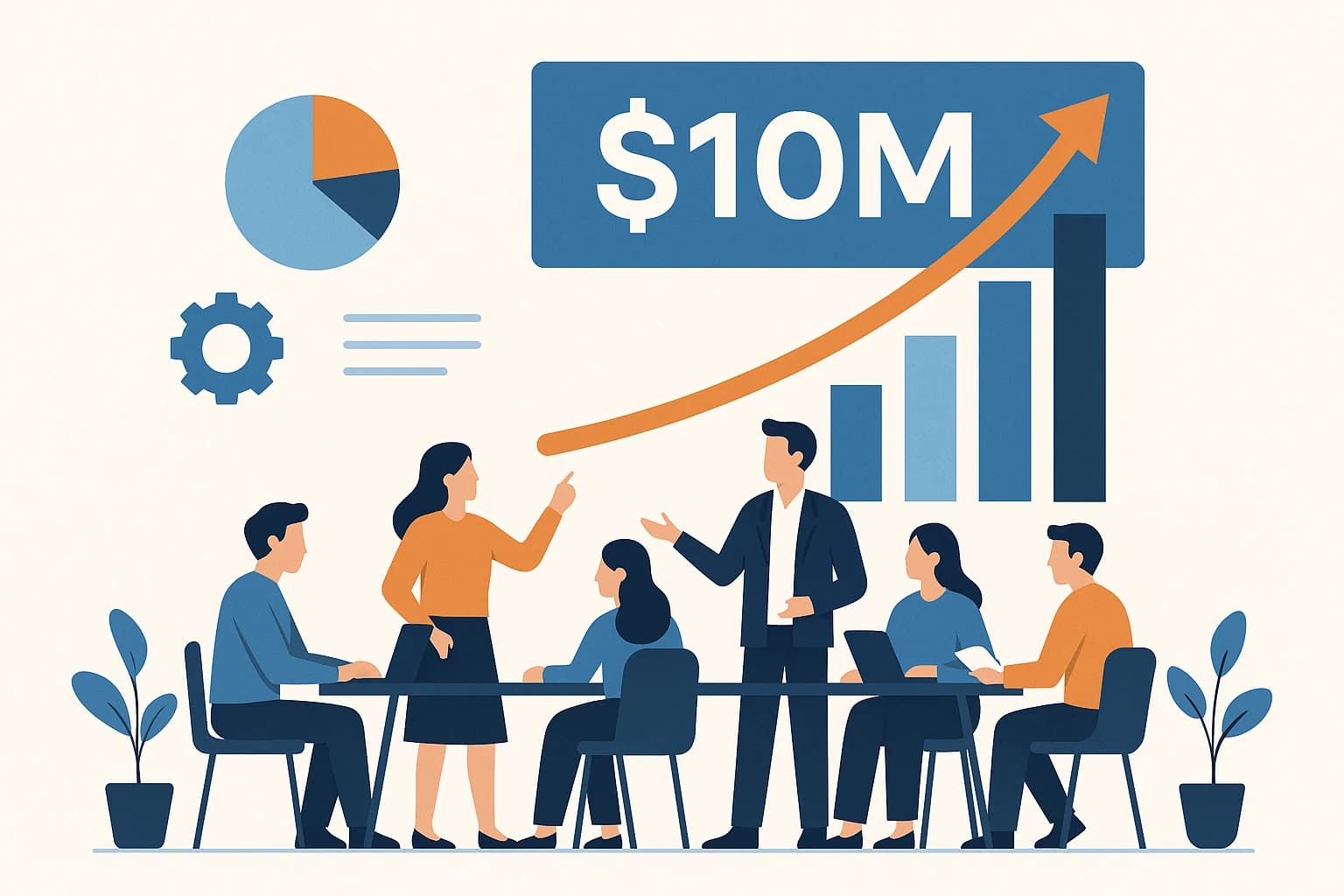
What if you could scale your company to $10 million in revenue, not with 100 employees, but with just 10?
This isn’t a far-off fantasy; it’s the dawn of a new strategic reality called The Super-Lean Business Model. This article will outline a new framework where a small, core human team, amplified by a powerful digital workforce of AI agents, can achieve a level of growth and operational efficiency that was previously unimaginable. It’s time to stop adding headcount and start adding intelligence.
The Breaking Point: Why the Traditional Scaling Model is Failing
The frustration you feel with the "hire-to-grow" model is valid. It's not just inefficient; it's a relic of a pre-digital age. Hiring one person to do one person's worth of work is a strategy for linear, not exponential, growth. Here’s why this old model is cracking under the pressure of the modern economy.
The real cost of a new hire goes far beyond their salary. Consider the hidden overhead:
- Financial Overhead: Benefits, payroll taxes, office space, new laptops, software licenses - these can add another 25-40% on top of a salary.
- Management Overhead: Every new team member requires time. Time for recruiting, onboarding, training, 1-on-1s, performance reviews, and team meetings. This is a direct tax on your most valuable leaders' time.
- Complexity & Communication Drag: As a team grows, communication pathways multiply exponentially. Decision-making slows down, information gets siloed, and the agility that made you successful in the first place begins to evaporate. Think about how long it takes to get a simple project approved in a 50-person company versus a 5-person one.
A large team is an anchor, not a sail. In a market that demands constant adaptation, a heavy headcount makes it incredibly difficult and expensive to pivot. The traditional scaling model doesn’t just cost you money; it costs you speed.
The New Blueprint: Introducing the "Super-Lean" Business Model
It’s time for a new blueprint. The Super-Lean model is not about simply cutting costs; it's a fundamental reimagining of how a company operates.
We define it as: A business structure where a small, highly strategic human team directs and manages a scalable, 24/7 digital workforce of AI agents to execute the majority of operational tasks.
The core of this model is a profound mindset shift. The goal is no longer to manage people doing tasks, but to design and manage systems that deliver outcomes. Your team’s role evolves from being "doers" to becoming "directors," "strategists," and "architects" of a highly efficient operational machine.
In this model, your company has two distinct workforces:
- The Human Core (The "10"): This is your small, elite team of experts. Their time is dedicated exclusively to the high-value, uniquely human work that drives growth: big-picture strategy, creative innovation, complex problem-solving, and building deep client relationships.
- The Digital Workforce (The "100s"): This is your scalable army of AI agents. They are the "doers," handling the vast majority of repetitive, process-driven tasks across every business function - from lead qualification to invoice processing.
Think of your human team as the air traffic control tower. They aren't flying the hundreds of planes, but they are directing them, ensuring they reach their destinations safely and efficiently. This is a model of human amplification, not replacement. It frees your best people from the drudgery of routine work so they can focus on what they - and only they - do best.
Anatomy of a $10M, 10-Person Company
To make this tangible, let’s imagine a hypothetical B2B consulting firm, "Innovate Solutions," operating on the Super-Lean model.
The Human Team (The 10):
- 2 Co-Founders (CEO/Vision, CTO/Product)
- 2 Senior Relationship Managers (High-touch sales & key accounts)
- 2 Project Strategists (Client success & project architecture)
- 1 Head of Marketing & Brand
- 1 Head of Finance & Operations
- 2 Senior Technical Experts (The core delivery specialists)
This team focuses on strategy, relationships, and the final 10% of complex, creative work. The other 90% is handled by their digital workforce.
The Digital Workforce in Action:
Marketing & Sales:
- Instead of hiring a junior marketer for research, an AI agent scours the web 24/7 to identify and qualify ideal customer profiles, adding them directly to the CRM. This is overseen by the Head of Marketing.
- Instead of a Sales Development Rep sending hundreds of emails, an AI agent runs personalized outreach campaigns at scale, A/B testing messages for optimal results.
- Instead of endless back-and-forth, an AI agent schedules meetings directly on the Relationship Managers' calendars based on their availability.
Operations & Client Delivery:
- Instead of a project coordinator manually onboarding clients, an AI agent sends welcome packets, collects necessary documents, and sets up project folders automatically. This is overseen by the Project Strategists.
- Instead of chasing status updates, an AI agent monitors project management tools, sends reminders for upcoming deadlines, and generates weekly progress reports for clients.
- Instead of a support rep answering the same questions repeatedly, an AI agent handles all first-tier customer inquiries via chat and email, only escalating complex issues to a Senior Expert.
Finance & Admin:
- Instead of an accounts receivable clerk, an AI agent generates and sends invoices, then follows up on late payments with a pre-defined, polite reminder sequence. This is overseen by the Head of Finance.
- Instead of a bookkeeper spending hours categorizing expenses, an AI agent processes receipts and generates real-time financial dashboards.
The "Super-Lean" Advantage: The Tangible Business Impact
Adopting this model isn't just an operational tweak; it fundamentally changes the financial and competitive DNA of your business.
Radical Cost Efficiency
- Studies consistently show that automation can reduce operational costs by 30-50%. This isn't just about saving on payroll. It’s about liberating capital that can be reinvested into growth engines like marketing, product development, and customer acquisition.
Non-Linear Scalability
- Your digital workforce can be scaled up or down instantly, with near-zero friction. Landed a project that requires 5x the normal reporting? You don't need to hire five temps for three months; you simply deploy five more AI reporting agents and then scale them down when the project is done. This gives you the ability to say "yes" to opportunities that would cripple a traditional organization.
Unprecedented Productivity & Speed
- AI agents work 24/7/365 without breaks, fatigue, or human error on repetitive tasks. Imagine your sales prospecting, client reporting, and invoice processing running flawlessly while your entire human team is asleep. This operational velocity allows you to serve clients and execute strategies at a speed your competitors simply can't match.
Focus on High-Value Work
- “The best way to build a billion-dollar company is to unbundle a single office job.” This model does exactly that. By automating the mundane, you elevate the role of your human team. This leads to higher job satisfaction, less burnout, and a culture focused on innovation and strategic impact, making you an employer of choice for top talent.
Your First Steps Towards a "Super-Lean" Future
Transitioning to this model is a journey, not an overnight switch. It starts with a simple shift in thinking and a few deliberate steps.
Step 1: The Mindset Shift. The next time you face a capacity problem, ask a new question. Instead of "Who can we hire to do this?" ask, "What is the system we can build to solve this?" This single change forces you to think about processes before people.
Step 2: Identify Your "Digital Workforce" Opportunities. Audit your team's time. Look for the "Three R's" - tasks that are Repetitive, Rule-based, and Routine. These are the prime candidates for your first AI agents. Common examples include data entry, report generation, scheduling, and standard email responses.
Step 3: Start with a Pilot Project. Don't try to automate your entire business at once. Pick one high-impact, low-risk process. Automate your invoice follow-up sequence or your initial lead qualification process. Measure the hours saved and the errors reduced, and use that success to build momentum.
Step 4: Choose the Right Partner. As you scale your digital workforce, you need more than just software. You need a partner who understands business strategy and process design, not just technology. Find someone who can help you architect the systems that will form the backbone of your future company.
The $10M Company of Tomorrow is Being Built Today
The old, linear model of scaling a business is over. The future belongs not to the companies with the most people, but to those with the most intelligent and efficient systems.
The Super-Lean model represents a shift from a people-scaled enterprise to a system-scaled one. It’s a future where small, brilliant, and agile human teams can build empires by leveraging a vast digital workforce. This creates a more resilient, profitable, and ultimately more human-centric company, where people are freed from robotic work to focus on the creative and strategic challenges that truly matter.
The question is no longer if this change is coming, but who will lead it. Building a Super-Lean business isn't just about being more efficient; it's about building the company of the future, today.