
The Future of Work for SMBs: Shifting from Doing to Directing Your Digital Workforce
By Dan Martuszewski
05/01/2026
The AI Co-Worker is Here. Are You Ready to Lead It?
Imagine your best employee could suddenly handle all the repetitive, time-consuming tasks on their plate. Instantly, they are freed up to focus on what truly matters: building client relationships, innovating new services, and growing your business. This isn't a fantasy; it's the new reality powered by AI.
Of course, the headlines often paint a different picture, one that stokes a common fear: "Will AI replace my team?"
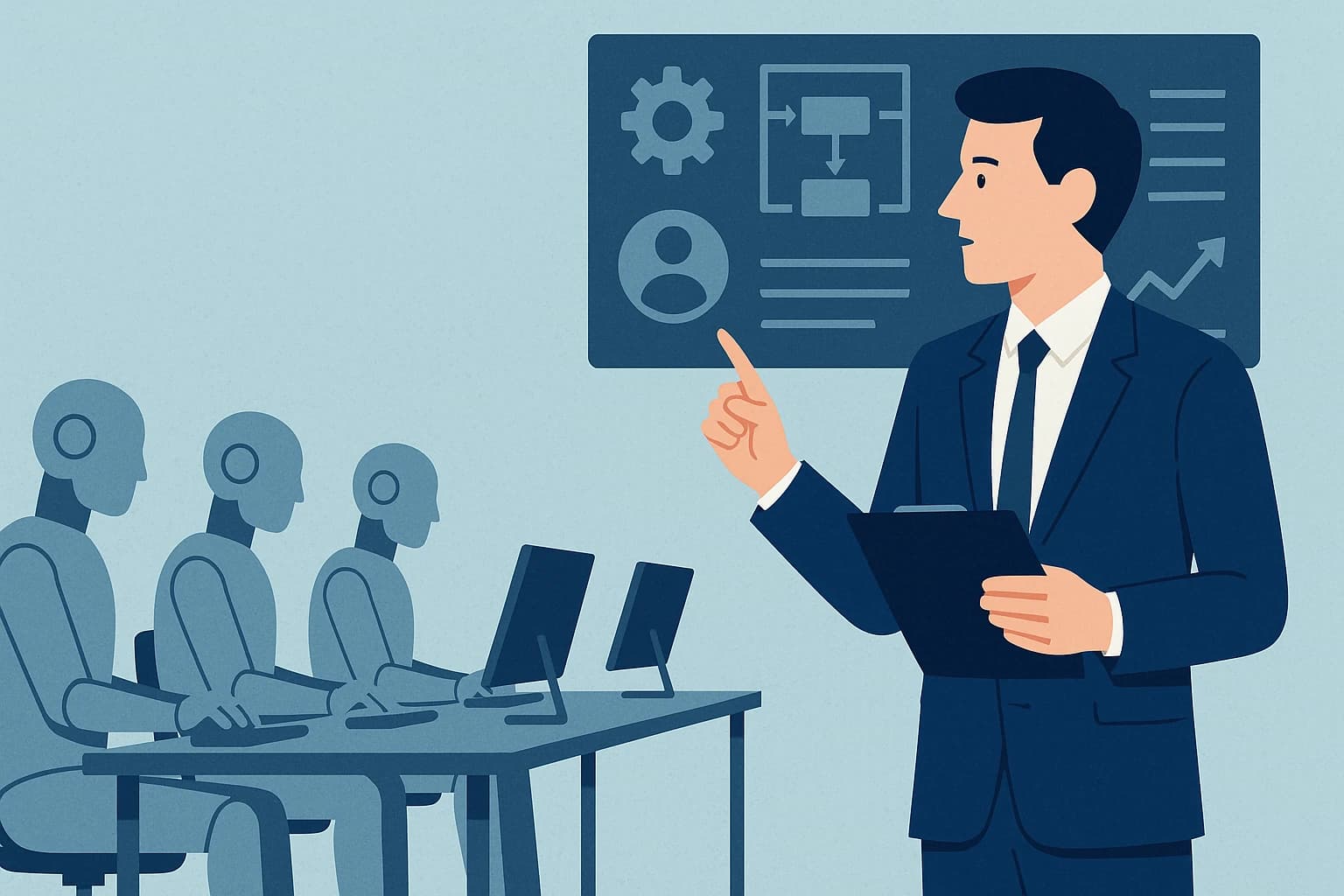
Let's reframe that question. The conversation isn't about replacement; it's about promotion. For everyone. The rise of AI and automation in small and medium-sized businesses (SMBs) is causing a fundamental shift in the nature of work. We are moving away from a model where employees primarily do the work, to one where they direct a digital workforce of AI agents to execute tasks. This transition elevates the human role, making it more strategic, creative, and valuable than ever before.
Understanding the Shift: From "Doers" to "Directors"
To grasp this change, it helps to look at where we've been and where we're going.
The "Old Way" (The World of "Doing")
For decades, many roles have been defined by "doing" tasks. These are the necessary, often manual, steps that keep a business running. Think about:
- Marketing: Manually posting on five different social media platforms every day, pulling simple data for weekly reports, or writing the first draft of a basic email newsletter.
- Sales: Diligently logging call notes in the CRM, sending templated follow-up emails, or trying to find a meeting time that works for everyone.
- Operations: Tedious data entry, manually processing vendor invoices, or cross-checking inventory lists against recent sales.
These tasks are essential, but they are also repetitive and process-driven. They don't always require the full depth of human creativity, empathy, or strategic thinking.
The "New Way" (The World of "Directing")
Now, imagine your team as conductors of an orchestra. The AI agents are the skilled musicians, capable of playing their instruments perfectly on command. The human is the conductor, responsible for setting the strategy (what song to play), designing the process (arranging the music), monitoring the performance, and making adjustments when something sounds off.
In this new world, the roles look very different:
- Marketing Director (of AI): Instead of manually posting, you design the entire social media campaign strategy for an AI to execute. You set the goals (e.g., "increase engagement with female entrepreneurs aged 30-45"), define the brand's voice, and then analyze the performance results the AI brings back to refine the next campaign.
- Sales Operations Director (of AI): Instead of just logging notes, you design the ideal customer follow-up workflow for an AI to manage. You decide the timing between touchpoints, the messaging for different customer segments, and the exact moment a human salesperson should be alerted to step in for a personal conversation.
- Customer Service Director (of AI): Instead of answering every basic query, you train the AI chatbot on your company's knowledge base. You set the rules for when a question needs to be escalated to a human expert for a complex, sensitive, or high-value issue.
The New "Job Description" for Your Human Team
As your team transitions from "doing" to "directing," their core responsibilities evolve. Their new job description focuses on uniquely human skills.
1. The Strategist & Goal-Setter
AI agents are excellent at executing tasks, but they need a clear objective. Humans define the "why" and the "what." Your team sets the business goals that the AI will work towards. For example, a manager decides the objective is to reduce customer response time by 50%. They then empower their team to design an AI-powered workflow to achieve it.
2. The Workflow Architect
This is a creative, puzzle-solving role. Employees will design, build, and continuously optimize the processes their AI agents follow. They map out the logic, like a flowchart: "When a new lead comes in from the website, the AI should automatically enrich the contact with company data, add it to the 'New Lead' pipeline in the CRM, and assign it to the next available sales rep." The human designs this entire intelligent process.
3. The Exception Handler & Problem-Solver
AI is brilliant at handling the 95% of tasks that are predictable. Your human team is essential for the 5% that are unexpected, complex, or require genuine empathy. An AI can process a standard invoice in seconds, but a human needs to step in when a long-time client has a unique billing issue that requires a nuanced, relationship-focused conversation.
4. The Quality Controller & Analyst
AI can gather and present data at an incredible scale. Humans are responsible for reviewing that output, ensuring quality, and extracting meaningful insights. An AI can generate a sales report showing what was sold, but a human sales manager analyzes it to spot a hidden trend - like a sudden drop-off in a specific region - and investigate the "why" behind the numbers.
The Dual Benefit: A Win for Your People and Your Business
This shift isn't just a change in process; it's a profound upgrade for your entire organization.
For Your Employees: More Fulfilling Work
- Increased Engagement & Job Satisfaction: Moving from monotonous tasks to strategic work creates a more stimulating and rewarding environment. People feel their intelligence and creativity are truly being valued.
- Skill Development: Your team develops high-demand skills in critical thinking, process design, data analysis, and strategy. This makes them more valuable to your company and empowers their long-term careers.
- Focus on Human Strengths: Team members are freed up to spend more time on activities where humans excel: building rapport with clients, creative brainstorming sessions, and mentoring colleagues.
For Your Business: A Powerful Competitive Edge
- Radical Efficiency: Accomplish more without necessarily increasing headcount. Let your digital workforce handle the volume, while your human team drives the value.
- Enhanced Innovation: When your best minds aren't bogged down in repetitive work, they have the mental bandwidth to think about new products, better services, and smarter ways of doing business.
- Improved Agility: With AI handling standardized processes, your business can pivot and adapt to market changes more quickly. Your team can focus on navigating the new landscape instead of maintaining old, rigid systems.
How to Prepare Your Team for the Shift: A Simple 3-Step Guide for Leaders
Making this transition doesn't have to be daunting. It starts with a few deliberate steps.
1. Cultivate the Right Mindset Communicate a positive vision. Frame AI as a "tool," a "co-pilot," or a "digital assistant," not a replacement. Emphasize that the goal is to make everyone's job better and more impactful, not obsolete. Lead by example by automating a small, annoying task in your own workflow and sharing the positive results.
2. Invest in "Director" Skills You don't need to hire a team of coders. Instead, focus on training for the "soft" skills that are rapidly becoming "hard" requirements for the modern workplace:
- Critical Thinking: The ability to analyze the results AI provides and ask smart questions.
- Process Mapping: The skill of outlining a workflow from start to finish.
- Creative Problem-Solving: The ingenuity to handle the exceptions that AI can't.
- Basic Data Literacy: The confidence to understand and interpret the data your AI agents are generating.
3. Start Small and Iterate Don't try to automate your entire business at once. Pick one process in one department that is a clear pain point - for example, managing and routing new sales inquiries from your website. Implement an AI agent to handle it, involve the relevant employee in "directing" it, and learn from the experience. Celebrate these small wins to build momentum and confidence across the company.
Your Future is Human-Led and AI-Powered
The future of work in your business isn't about humans versus machines. It's about humans with machines, working in partnership. The role of your team is elevating from hands-on execution to strategic direction, from doing the work to designing the work.
This shift creates a more resilient, innovative, and efficient business. More importantly, it creates a more engaged, skilled, and satisfied workforce. Your people are your greatest asset, and by providing them with a digital workforce to command, you unlock their true potential.
What is one repetitive task in your business you could hand over to a digital worker this week, freeing up your team to focus on what they do best?